

Wyoming Landlord-Tenant Law 2026: A Practical Guide for Landlords
Last reviewed: September 16, 2026
Wyoming is often considered a landlord-friendly state, but that doesn't mean landlords can do whatever they want. Wyoming law establishes rules for habitability, security deposits, notices, eviction, abandoned property, and other parts of the landlord-tenant relationship. In most cases, Wyoming landlords are also subject to Federal Fair Housing laws. It is important for landlords and property managers to understand Wyoming and Federal laws.
Does Wyoming Have a Landlord-Tenant Act?
Yes.
Wyoming's primary residential landlord-tenant statute is the Residential Rental Property Act, found at Wyo. Stat. §§ 1-21-1201 through 1-21-1211. Wyoming's eviction procedure—called Forcible Entry and Detainer, or FED—is primarily found in Wyo. Stat. §§ 1-21-1001 through 1-21-1016.
Compared with some states, Wyoming law leaves a lot of gray area in the landlord-tenant relationship. That makes a well-written lease especially important.
Keep in mind a lease provision does not automatically override state or federal law. Just because the landlord and tenant agree to a specific provision doesn't mean it is legal or enforceable. When the issue involves eviction, discrimination, habitability, security deposits or another legally sensitive subject, the statute should be checked before striking an agreement.
What Are a Wyoming Landlord's Responsibilities?
Wyoming requires an owner or property manager to maintain a residential rental unit in a safe and sanitary condition fit for human habitation.
The law specifically requires landlords to maintain:
- Common areas in a sanitary and reasonably safe condition.
- Electrical systems.
- Plumbing.
- Heating.
- Hot and cold water.
- Other appliances and facilities specifically required by the rental agreement.
Wyoming law focuses heavily on conditions that affect the physical health or safety of an ordinary renter. The statute also allows certain duties to be assigned or modified through an explicit written agreement signed by the parties, subject to other applicable law. Wyo. Stat. §§ 1-21-1202 and 1-21-1203.
The practical lesson for landlords is simple: put landlord and tenant responsibilities in writing. If it isn't in writing, it may as well not exist. But don't assume that a written lease eliminates every statutory obligation.
What Are a Wyoming Tenant's Responsibilities?
Wyoming law also imposes specific responsibilities on tenants.
A tenant generally must:
- Keep the rental reasonably clean and safe.
- Properly dispose of garbage and waste.
- Keep plumbing fixtures reasonably sanitary.
- Use electrical, plumbing, heating and other systems reasonably.
- Use the property for its intended purpose.
- Avoid exceeding the permitted number of occupants without written approval.
- Stay current on payments required by the rental agreement.
- Comply with lawful lease requirements.
- Remove personal property and garbage at move-out.
- Return the property in the same condition as received, minus ordinary wear-and-tear.
Tenants also may not intentionally or negligently damage the property, interfere with another person's peaceful enjoyment of the property or unreasonably deny a landlord access for repairs, inspections or showing the property for rent or sale. Wyo. Stat. §§ 1-21-1204 and 1-21-1205.
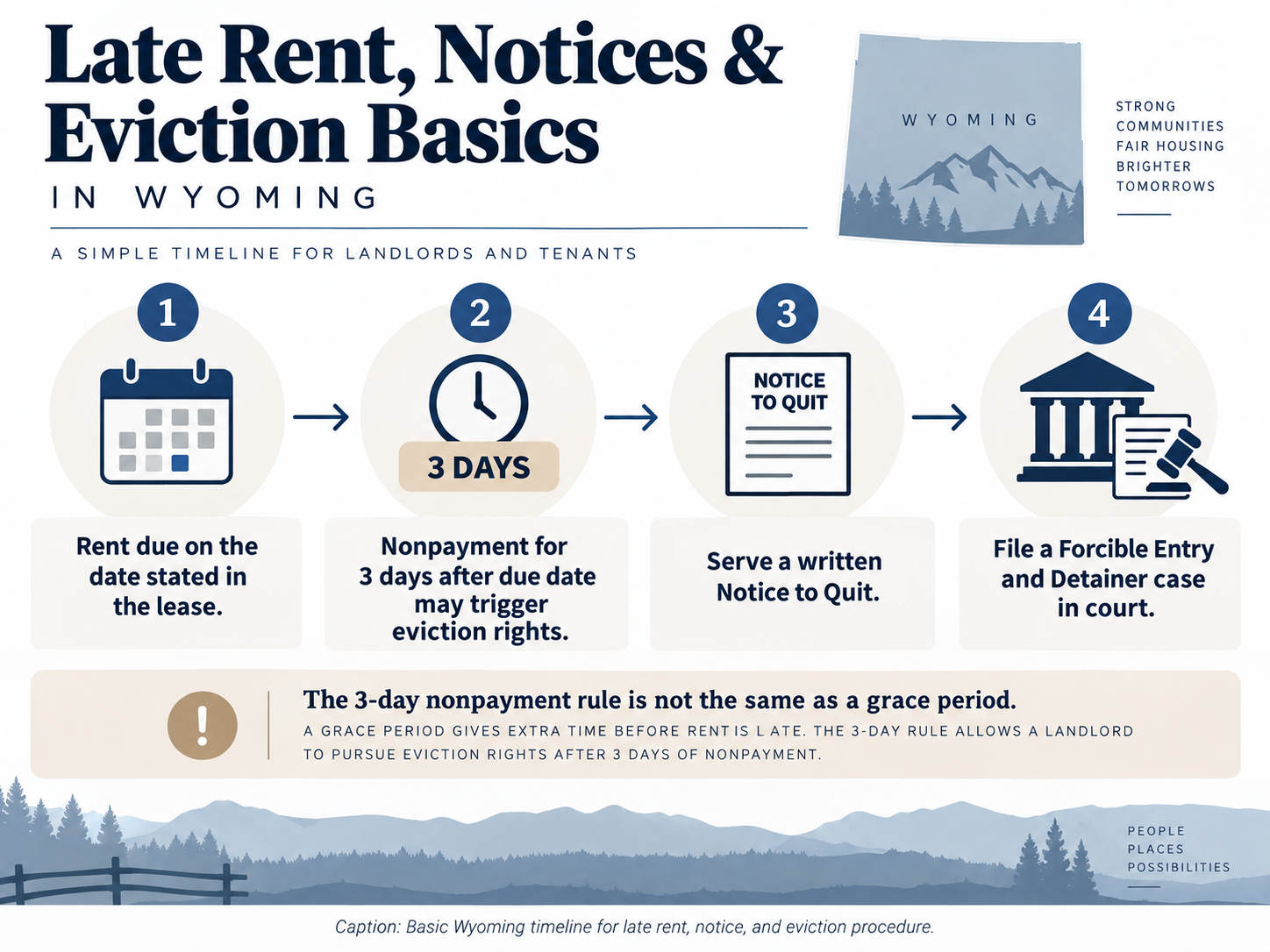 Wyoming Late Rent, Notices, and Eviction
What Happens When Rent Is Late in Wyoming?
Do not confuse Wyoming's eviction timing with a statutory grace period.
Under Wyo. Stat. § 1-21-1002, a Forcible Entry and Detainer action may be brought against a tenant who has failed to pay rent for three days after it is due. The landlord may charge a late fee any time after the rent is late, meaning the day after rent is due according to the lease.
The Wyoming Judicial Branch also notes that a court judgment may include unpaid rent, late fees and other costs provided for in the rental agreement.
A professionally written lease should clearly state:
- When rent is due.
- When a late fee applies.
- The amount or method for calculating the late fee.
- Acceptable payment methods.
- What happens after nonpayment.
What Notices Do Wyoming Landlords Need to Give?
There is no single notice period that applies to every landlord-tenant situation.
For an eviction action, Wyo. Stat. § 1-21-1003 requires the landlord to give the tenant(s) a written 3-Day Notice to Pay or Quit. Once served, the tenant has three days to pay everything owed or risk eviction.
For nonpayment, the Wyoming Judicial Branch describes the process as beginning after the tenant has failed to pay rent for three days after it becomes due, followed by the required Notice to Quit and court process.
Different rules or notice requirements may apply to:
- Month-to-month tenancy termination.
- Repair demands.
- Lease expiration.
- Abandoned property.
- Notices required by the lease itself.
The safest practice is to identify what kind of notice you are giving before choosing the notice period.
What Happens When a Tenant Violates the Lease?
A lease is only useful if the landlord applies it consistently! It is imperative you understand your lease and are prepared to enforce it quickly and efficiently.
Wyoming law allows eviction proceedings in several situations, including nonpayment, holding over after the tenancy ends, and violations of tenant duties contained in Wyo. Stat. §§ 1-21-1204 and 1-21-1205. The Wyoming Judicial Branch also identifies violations of lease terms as potential grounds for eviction.
Common examples include:
- Unauthorized occupants.
- Unauthorized pets.
- Property damage.
- Failure to pay rent.
- Interfering with other residents.
- Other material violations of the rental agreement.
Document the violation in writing. Follow the lease and applicable notice requirements, and avoid making exceptions for one resident that you would not make for another without a legitimate reason.
Most importantly, a landlord should not attempt to bypass the judicial eviction process by simply changing locks or physically removing a tenant. The Wyoming Judicial Branch explains that the landlord must obtain a court order before the tenant can be removed.
What Is the Basic Wyoming Eviction Process?
Wyoming eviction is a court process.
The Wyoming Judicial Branch describes the basic procedure as three stages:
1. Notice to Quit
The landlord first serves the required written notice. A typical eviction notice is a three-day Notice to Quit.
2. Forcible Entry and Detainer case
If the matter is not resolved, the landlord files a Forcible Entry and Detainer action in Circuit Court.
3. Writ of Restitution
If the landlord obtains judgment for possession and the tenant does not leave, the court can issue a Writ of Restitution authorizing the sheriff to restore possession to the landlord.
The summons generally provides a relatively short time before trial. Under Wyo. Stat. § 1-21-1004, service must generally occur no less than three and no more than twelve days before the trial date.
Can the landlord just change the locks?
No.
A Notice to Quit does not itself authorize a landlord to physically remove a tenant or lock the tenant out. The landlord must use the court process.
Attempting to evict the tenant outside of the legal system is referred to as a "Self Help Eviction" and is strictly forbidden by statute. Some examples include removing locks or doors, turning off utilities, or removing tenant's belongings, and intimidation or harassment.
What Can a Wyoming Landlord Do With Abandoned Property?
Wyoming has a specific abandoned-property statute: Wyo. Stat. § 1-21-1210.
After the landlord has regained lawful possession following termination of the rental agreement, the owner may immediately dispose of property reasonably believed to be hazardous, perishable, valueless or trash. For example, American West Realty and Management will immediately remove any food items or trash that may attract pests, create odors, cause property damage, or pose a safety hazard.
Valuable property requires additional steps.
The statute generally requires written notice describing the property and informing the former tenant that the property may be disposed of if the tenant does not retrieve it or respond in writing within seven days after service of the notice. If the tenant responds, additional statutory holding requirements apply before the landlord may retain or dispose of the property.
In some cases the tenant's belongings may be moved to storage so the landlord can secure and clean the rental. The landlord may be entitled to reasonable moving and storage costs.
💡 Landlord tip
Do not improvise abandoned-property procedures. Photograph what was left, inventory anything of apparent value, document how notice was served and follow the Wyo. Stat. § 1-21-1210 before disposing of any property.
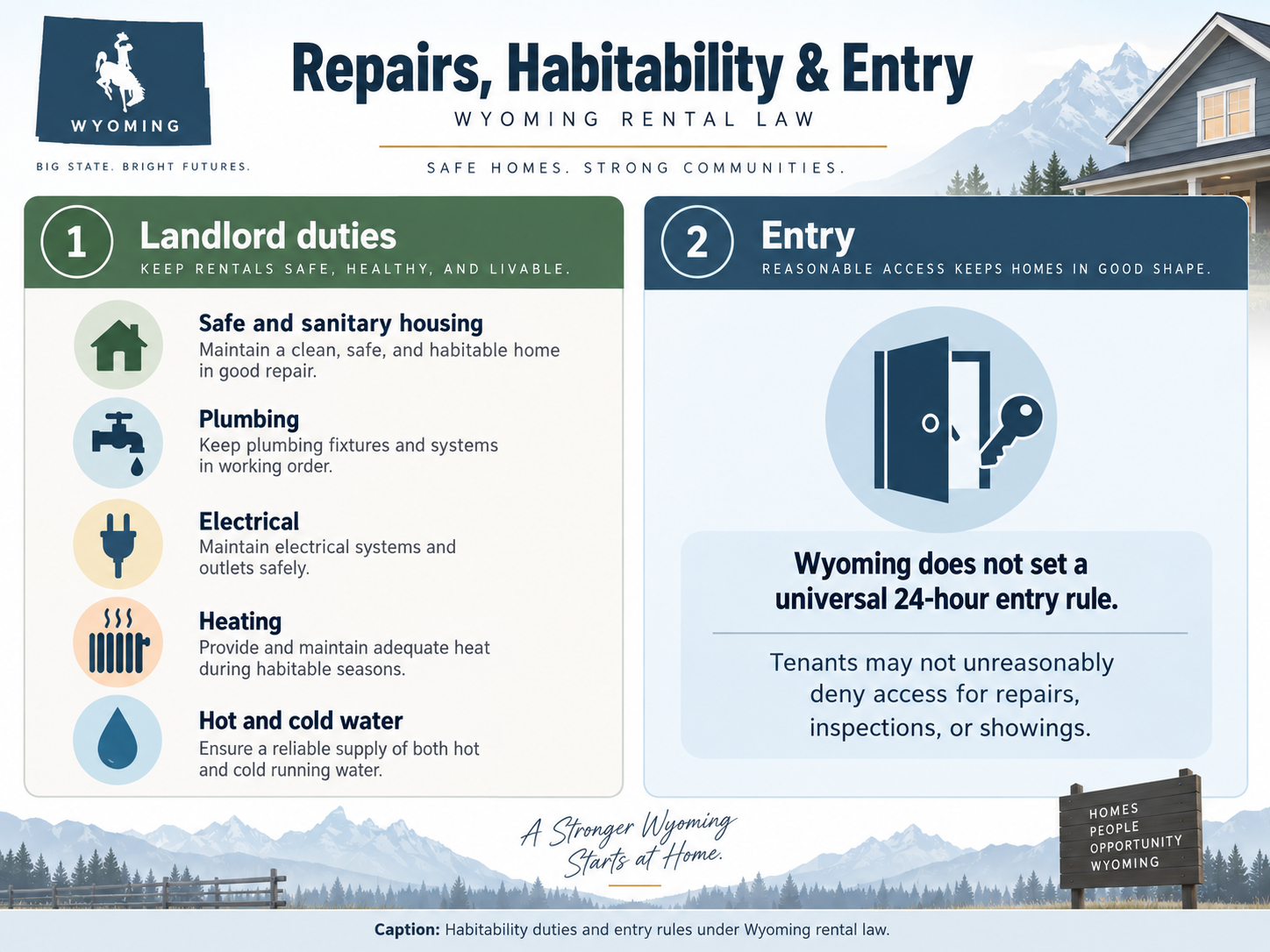 Repairs, Habitability, and Entry in Wyoming
What Are Wyoming's Rules for Repairs and Habitability?
Wyoming landlords are required to keep residential rentals reasonably safe, sanitary and fit for human occupancy, and they must maintain essential systems described by statute.
Wyoming also has a specific procedure tenants must follow when asserting statutory repair rights.
A tenant who is current on required payments and believes a health or safety condition violates the Residential Rental Property Act must notify the landlord in writing, describe the condition, and identify the requested corrective action.
The landlord then has a reasonable time to begin correcting the condition or dispute the tenant's claim in writing.
If the issue continues, Wyoming law provides for a second formal notice and ultimately a potential court action. Wyo. Stat. §§ 1-21-1203 and 1-21-1206.
Can a Wyoming tenant withhold rent because repairs are needed?
Generally, no.
The Wyoming Judicial Branch specifically warns tenants not to simply stop paying rent because they believe repairs are needed. Tenants seeking remedies under the statutory repair process generally must remain current on their required payments and follow the required notice procedure. If the tenant follows the statute and the landlord still fails to make the necessary repair, there may be a process for a tenant to withhold rent. We recommend consulting an attorney before taking this step.
A landlord and tenant can sometimes agree on another solution—for example, the landlord may authorize the tenant to complete the repair and receive a credit. Any agreement of this type should be clearly explained in writing and signed by all parties.
Can a Wyoming Landlord Enter a Rental Property?
Wyoming law does not establish a general statewide rule requiring exactly 24 hours' notice before every landlord entry.
Instead, Wyo. Stat. § 1-21-1205 provides that a renter may not unreasonably deny access or withhold consent when the owner, agent or manager needs entry to:
- Make repairs.
- Inspect the property.
- Show the property for rent.
- Show the property for sale.
The Wyoming Judicial Branch similarly notes that leases commonly permit landlord entry at reasonable times and with reasonable notice. For example, it is not reasonable for a landlord to enter the home at 9am on a Sunday with only one hour of notice, unless a true emergency exists. Reasonable notice is generally a day or more, and a reasonable time to enter would be after 8am and before 8pm on a weekday. Landlords should make an effort to avoid unnecessary disruptions to the tenant.
At the same time, tenants cannot unnecessarily prevent landlord's entry for inspections, repairs, or to show the property for rent or sale. The property belongs to the landlord, and they have a right to monitor, maintain, or show their property.
Because Wyoming law does not supply a single universal advance-notice period for ordinary entry, the lease should clearly state the landlord's entry policy, including reasonable advance notice and emergency access.
Giving reasonable notice whenever circumstances permit is also simply good management. Surprise entries generate unnecessary conflict even when the landlord may have a legitimate reason to enter.
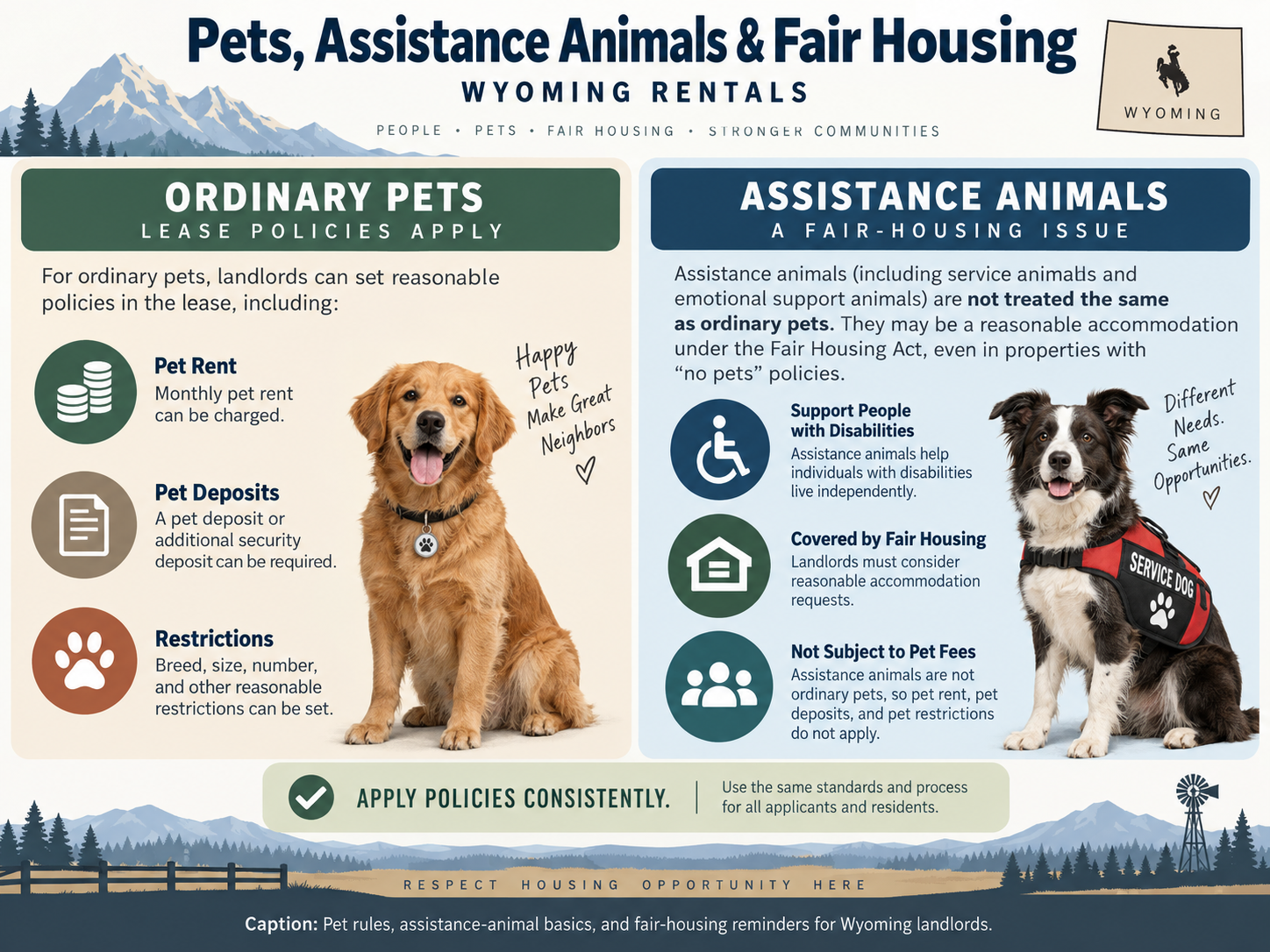 Pets and Assistance Animals in Wyoming
What Are the Rules for Pets and Assistance Animals?
For ordinary pets, landlords generally establish their rules through the rental agreement.
A lease can address subjects such as:
- Whether pets are permitted.
- Types, numbers, or even size of pets.
- Refundable or non-refundable pet deposits.
- Pet rent or fees.
- Pet-related damage.
- Animal behavior and sanitation.
Assistance animals are different.
Federal Fair Housing law prohibits housing providers from discriminating because of disability. HUD treats qualifying assistance-animal requests as requests for reasonable accommodation, so an assistance animal should not treated as a pet.
HUD states that qualifying service and emotional-support animals are not subject to ordinary pet fees or pet deposits. Where a disability or disability-related need is not apparent, documentation may be appropriate under Fair Housing rules.
Landlords should therefore avoid automatically applying a "no pets" policy, pet rent, breed rule or pet deposit to an assistance-animal request without first going through the reasonable-accommodation process.
There's a lot of fraud surrounding assistance animals, so landlords should have a good understanding of HUD guidance, a screening process to avoid fraudulent requests, and a written policy to ensure they apply their policy equally and objectively.
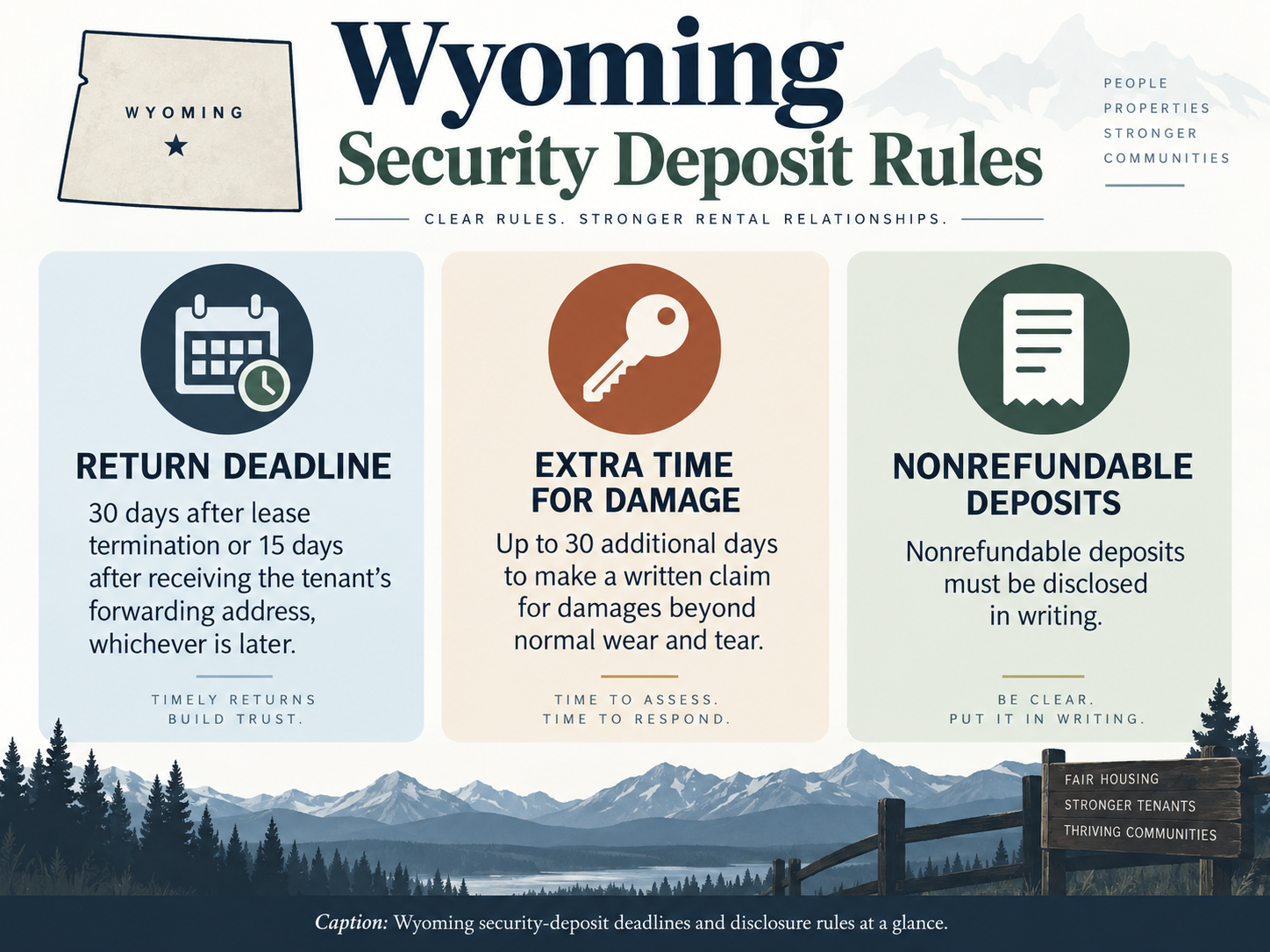 Wyoming Security Deposit Rules
How Long Does a Wyoming Landlord Have to Return a Security Deposit?
This is one of the areas where landlords need to pay close attention to the calendar.
Under Wyo. Stat. § 1-21-1208, the landlord generally must deliver or mail the balance of the security deposit, prepaid rent and a written itemization of deductions within:
30 days after termination of the rental agreement, or 15 days after receiving the tenant's new mailing address, whichever is later.
If there is damage to the rental property, the statute allows an additional 30 days.
The landlord may generally apply the deposit toward:
- Unpaid rent.
- Damage beyond reasonable wear-and-tear.
- Cleaning necessary to return the unit to the same condition it was upon occupancy.
- Other costs authorized by the rental agreement.
If any portion of a deposit is nonrefundable, Wyoming law requires that fact to be stated in the rental agreement and disclosed in writing when the deposit is collected. Wyo. Stat. § 1-21-1207.
A separate utilities deposit has its own statutory deadlines.
💡 Landlord tip
Take detailed photos before the tenant occupies and after they vacate, keep copies of invoices and receipts, and itemize deductions clearly. A charge is much easier to defend in court when the landlord has evidence supporting it.
How Do Month-to-Month Tenancies End in Wyoming?
The Wyoming Judicial Branch states that a landlord may terminate a month-to-month tenancy without alleging a lease violation when the tenant is given a full month's notice.
Landlords should also review the rental agreement because it may contain specific notice provisions governing termination.
A month-to-month tenancy should not be confused with a tenancy where the resident simply stays after a fixed-term lease expires. The lease language and the parties' conduct can affect the analysis, so unusual situations should be reviewed individually.
What Fair Housing Laws Apply to Wyoming Landlords?
Wyoming landlords must also consider Federal Fair Housing law.
The Fair Housing Act prohibits housing discrimination based on:
- Race.
- Color.
- National origin.
- Religion.
- Sex.
- Familial status.
- Disability.
Fair Housing issues can arise during much more than applicant screening. They can involve:
- Advertising.
- Showing properties.
- Qualification standards.
- Occupancy rules.
- Lease enforcement.
- Reasonable accommodations.
- Assistance animals.
- Maintenance and services.
- Renewals.
- Terminations.
- Evictions.
A policy that sounds neutral can still create Fair Housing risk if it is applied inconsistently.
Landlords should establish written qualification criteria and operational policies before an applicant or tenant creates a difficult situation. Consistent systems are easier to defend than decisions made case by case.
Wyoming Landlord-Tenant Law Quick Reference
| Issue | General Wyoming Rule |
|---|---|
| Rent unpaid | FED may be available after rent remains unpaid for 3 days after due date |
| Eviction notice | At least 3 days before filing the FED action |
| Security deposit | Generally 30 days after termination or 15 days after new address, whichever is later |
| Property damage at move-out | Deposit deadline may be extended another 30 days |
| Nonrefundable deposit | Must be disclosed in writing when collected |
| Repair request | Tenant generally must give written notice and follow statutory process |
| Rent withholding for repairs | Tenants generally should not withhold rent |
| Landlord entry | No universal statewide 24-hour rule; tenant cannot unreasonably deny legitimate access |
| Abandoned valuable property | Statutory notice process includes an initial 7-day response period |
| Month-to-month termination | Wyoming Judicial Branch states a full month's notice |
| Self-help eviction | Do not change locks or physically remove tenant without court process |
| Assistance animal | Treat as a Fair Housing reasonable-accommodation issue, not an ordinary pet |
Frequently Asked Questions About Wyoming Rental Laws
Is Wyoming a landlord-friendly state?
Wyoming is commonly described that way because the state imposes fewer detailed statutory requirements in some areas than many other states. But Wyoming landlords still have enforceable obligations involving habitability, deposits, eviction procedures and other matters, and federal Fair Housing law remains important. We like to think of Wyoming as "justice-friendly" rather than "landlord friendly."
How long does a Wyoming landlord have to return a security deposit?
Generally 30 days after termination of the rental agreement or 15 days after receiving the renter's forwarding address, whichever is later. If there is property damage, Wyoming law allows an additional 30 days. Wyo. Stat. § 1-21-1208.
Does Wyoming require 24 hours' notice before landlord entry?
Wyoming's Residential Rental Property Act does not establish a blanket 24-hour advance-notice rule. It does prohibit tenants from unreasonably denying access for repairs, inspections or showings. The lease should address entry procedures. Wyo. Stat. § 1-21-1205.
Can a Wyoming tenant stop paying rent because repairs have not been completed?
Tenants should not simply withhold rent. Wyoming's statutory repair remedy generally requires the tenant to remain current and follow a written notice process.
How soon can a landlord start an eviction for unpaid rent?
Wyoming law allows a Forcible Entry and Detainer proceeding for failure to pay rent for three days after it becomes due. The landlord must also comply with the Notice to Quit requirement before filing the court action. Wyo. Stat. §§ 1-21-1002 and 1-21-1003.
Can landlords charge pet fees in Wyoming?
Ordinary pet rules and charges are generally addressed by the rental agreement. Assistance animals require a different analysis under federal Fair Housing law and should not automatically be subjected to ordinary pet fees or deposits.
Can a Wyoming landlord throw away belongings left behind?
Not automatically. Trash and property reasonably believed to be hazardous, perishable or valueless can be handled differently, but potentially valuable abandoned property is subject to the notice process in Wyo. Stat. § 1-21-1210.
How much notice is required to terminate a month-to-month rental?
The Wyoming Judicial Branch states that a month-to-month tenancy can be terminated without cause with a full month's notice. The lease should also be reviewed for applicable termination provisions.
Does this apply to Park County, Wyoming landlords?
These Wyoming statutes generally apply statewide, including to residential landlords in Cody, Powell and elsewhere in Park County. Local ordinances, property type, federal programs and the specific rental agreement can create additional requirements.
The Bottom Line for Wyoming Landlords
Wyoming gives landlords substantial ability to define the rental relationship through a well-written lease, but procedure still matters.
The most expensive landlord mistakes often come from shortcuts: undocumented property condition, inconsistent lease enforcement, poorly written notices, missed deposit deadlines, informal eviction attempts and treating an assistance-animal request like an ordinary pet request.
Good property management is largely about having the correct process in place before something goes wrong.
Sources and Further Reading
- Wyoming Legislature — Residential Rental Property Act and Forcible Entry and Detainer statutes
- Wyoming Judicial Branch — Evictions
- Wyoming Judicial Branch — Security Deposits
- Wyoming Judicial Branch — Requesting Repairs
- U.S. Department of Housing and Urban Development — Fair Housing Rights and Obligations
Important Disclaimer
This article provides general educational information about Wyoming residential landlord-tenant law and is not legal advice. Laws, court interpretations and administrative guidance can change, and the correct procedure may depend on the facts, property type, rental agreement and applicable federal or local law. Landlords and tenants facing a specific legal dispute should consult a Wyoming attorney. This article should be reviewed for legal accuracy before publication and reviewed periodically for statutory changes.