
A tenant stopped paying rent today. How long before a Wyoming landlord can actually regain possession?
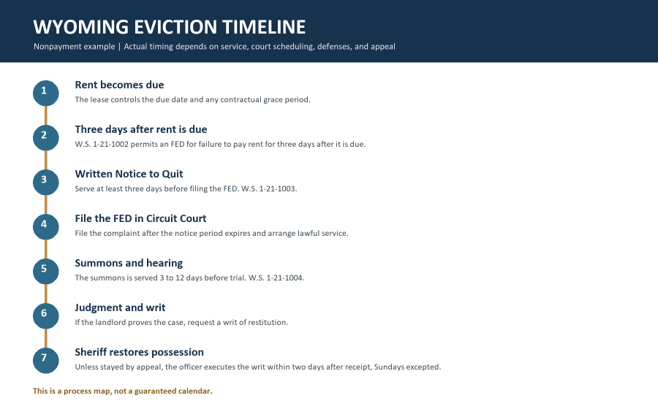
Direct answer. A Wyoming landlord usually cannot file a nonpayment eviction case the day rent is missed. Wyoming law allows a forcible entry and detainer proceeding after the tenant has failed to pay rent for three days after it is due. The landlord must also serve a written Notice to Quit at least three days before filing. After filing, the summons must be served not less than three and not more than twelve days before trial. If the landlord wins, the court may enter judgment for restitution; the landlord then requests a writ of restitution, and the sheriff or other authorized officer restores possession. Unless an appeal stays enforcement, the officer must execute the writ within two days after receiving it, excluding Sundays.
That sequence creates statutory minimum intervals, but it does not produce a guaranteed move-out date. Service problems, court scheduling, disputed facts, continuances, a jury demand, settlement, or an appeal can extend the Wyoming eviction timeline. A landlord in Cody or elsewhere in Park County should confirm current filing, service, and scheduling requirements with the Circuit Court of the Fifth Judicial District before relying on a calendar estimate.
Important correction about the first three days. The lease determines when rent is due and whether the parties agreed to a grace period or late-fee timing. Wyoming does not create a general statutory rent grace period. Separately, W.S. 1-21-1002(a)(i) permits an FED after failure to pay rent for three days after it is due, and W.S. 1-21-1003 requires at least three days' written notice before the action is commenced.
What is the Wyoming eviction timeline?
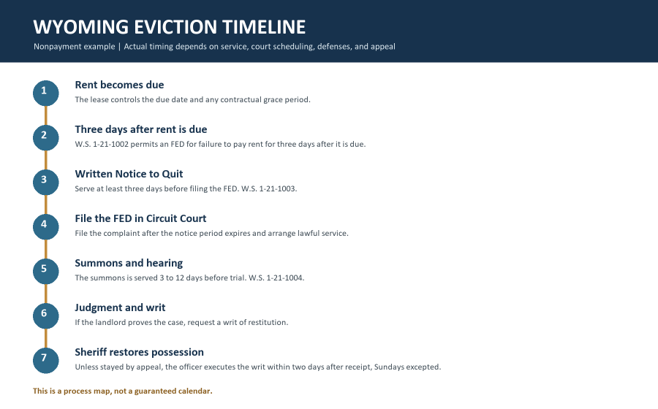
Wyoming eviction timeline for a typical nonpayment case. The diagram shows legal stages, not a guaranteed completion date.
When does rent become delinquent under a Wyoming lease
Start with the lease. The agreement should state the rent amount, due date, accepted payment method, late-fee provisions, and any contractual grace period. If rent is due on the first, a company ledger may label the account delinquent on the second, after a stated contractual grace period, or under another documented internal rule. That label does not change the statutory conditions for filing an FED.
Keep these three concepts separate:
- Lease term: the parties' contract controls when rent is due and any agreed grace period.
- Statutory threshold: W.S. 1-21-1002(a)(i) allows an FED after failure to pay rent for three days after it is due.
- Company procedure: a property manager may use reminder calls, ledger flags, approval steps, or a later escalation date. Those are business procedures, not Wyoming legal requirements.
What notice must a Wyoming landlord give before filing an eviction
W.S. 1-21-1003 requires the party who wants to commence an FED to notify the adverse party to leave the premises. The written notice must be served at least three days before the action begins. The statute says service may be made by leaving a written copy with the defendant or, if the defendant cannot be found, at the defendant's usual place of abode or business.
The Wyoming Judicial Branch describes the first stage as a written Notice to Quit and provides statewide landlord forms and instructions. Use the current court form or have your attorney prepare a notice tailored to the case. Identify the premises, tenant, ground for termination, required action, deadline, and landlord or agent accurately. Preserve a copy and proof of service.
When does a three day notice in Wyoming expire
Do not file before the required notice interval has fully run. W.S. 1-21-1003 measures the notice requirement as at least three days before commencing the action. Calendar questions can become fact-specific when service occurs late in the day, a courthouse is closed, or the deadline falls near a weekend or holiday. Use a conservative filing date and confirm local practice rather than treating a template's deadline as automatic.
For nonpayment, two different three-day concepts may appear in the same file. The first is the failure to pay for three days after rent is due under W.S. 1-21-1002(a)(i). The second is the written notice served at least three days before filing under W.S. 1-21-1003. Calling the first interval a statewide rent grace period blurs this distinction and should be avoided.
How does a landlord file a Forcible Entry and Detainer case in Wyoming
After the statutory ground exists and the Notice to Quit period has expired, the landlord files a complaint for forcible entry and detainer in Circuit Court. For a Park County Wyoming eviction, confirm the correct Park County Circuit Court location and current procedures. The complaint should match the notice and the lease, name the proper parties, describe the rental property, state the legal ground, and request possession and any other recoverable relief.
The Wyoming Judicial Branch publishes an FED complaint, summons, service instructions, judgment form, and writ form. Filing is not the same as removing the tenant. The tenant remains entitled to proper service and a hearing process.
If the rental is occupied by more than one resident, your court filing should be filed against each resident separately.
What happens after the Wyoming eviction case is filed
The court issues a summons stating the cause of the complaint and the time and place of trial. Under W.S. 1-21-1004, the summons must be served not less than three and not more than twelve days before the trial date. The statute also says a tenant does not have to file a written answer as a condition of participating fully at trial.
NOTE: Many tenants will recognize their guilt and vacate the rental before the hearing. When this happens, the landlord may elect to continue with the FED hearing, or they may request to vacate the hearing and move on.
At the hearing, the landlord must prove the right to possession. A useful hearing file includes the signed lease and amendments, complete ledger, Notice to Quit, proof of service, complaint and summons, payment communications, photographs or inspection reports for a violation case, and witnesses with personal knowledge. A tenant may contest the amount due, service, the alleged breach, the landlord's right to possession, discrimination, retaliation, or other defenses supported by law and facts.
American West Realty and Management has handled dozens of eviction cases. In our experience, tenants do not present a valid defense. Stick with the facts, provide documentation of the violations, and you'll win the case.
What judgment can a Wyoming court enter in an eviction case
Under W.S. 1-21-1008(a), if the court finds the complaint true, it enters judgment for restitution of the premises and costs. If the complaint is true only in part, the judgment may cover only that part, with costs allocated as the court considers equitable. If the landlord does not prove the complaint, the court enters judgment against the landlord for costs.
In a nonpayment case, W.S. 1-21-1008(b) requires findings about the rent due at the hearing and the agreement's terms governing the amount and timing of rent. The court may enter a separate money judgment for rent, costs, and attorney fees as provided by the lease. The money execution is separate from the writ that restores possession.
What is a Writ of Restitution in Wyoming
A writ of restitution is the court's command authorizing the officer to restore possession to the landlord. After judgment for restitution, W.S. 1-21-1012 directs the court to issue the writ when the landlord, agent, or attorney requests it. Winning the case does not itself authorize the landlord to change the locks or physically remove the tenant.
How does the sheriff restore possession in Wyoming
The landlord delivers or otherwise coordinates the writ through the authorized officer under local practice. W.S. 1-21-1013 states that, unless the tenant appeals, the officer shall execute the writ within two days after receiving it, Sundays excepted, by restoring the landlord to possession. Coordinate access, locksmith needs, and handling of personal property with the sheriff's office and counsel. Do not improvise a removal before the officer executes the writ.
How do nonpayment eviction cases work in Wyoming
For nonpayment, build the case around the lease due date and an accurate ledger. Confirm that payments, concessions, credits, returned payments, subsidies, and late fees are recorded correctly. The statutory ground under W.S. 1-21-1002(a)(i) is failure to pay rent for three days after it is due. Then serve the separate Notice to Quit required by W.S. 1-21-1003 before filing.
If the tenant pays, tenders partial payment, proposes a plan, or the landlord accepts money after notice, document the agreement in writing and obtain legal advice about the effect on the pending notice or case. The Judicial Branch warns tenants that partial payment alone does not necessarily stop an eviction without a written agreement allowing the tenant to stay.
How do lease violation evictions work in Wyoming
A lease violation case depends on the exact lease language, the facts, and any statutory duties. Identify the clause, document the conduct, and apply any notice or cure rights in the lease or applicable law. Examples may include an unauthorized occupant or pet, substantial property damage, or other material breach, but the landlord must prove the actual violation rather than rely on a conclusion in a management note.
Do not reuse nonpayment language when the ground is a lease violation. The notice, complaint, evidence, and requested remedy should tell one consistent story.
How do holdover evictions work in Wyoming
W.S. 1-21-1002(a)(i) also allows an FED against tenants holding over after their terms. A holdover case requires proof that the tenancy ended and the tenant remained. Review the lease term, renewal language, termination notices, acceptance of rent, and any month-to-month arrangement. The Wyoming Judicial Branch says a month-to-month tenant may be evicted without cause when given a full month's notice, but the specific agreement and facts should be reviewed before notice is served.
What can a Wyoming landlord do during an eviction?
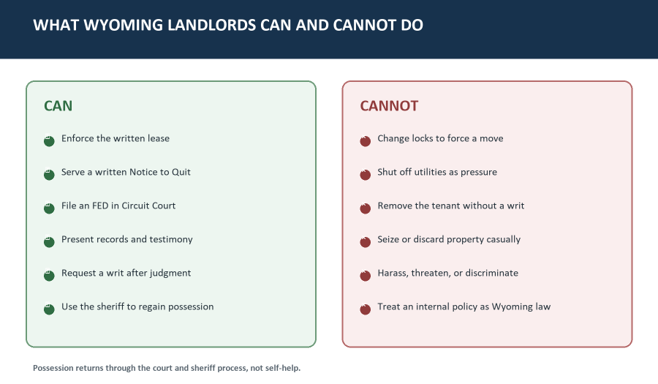
A landlord may enforce legal rights through notice, court, judgment, writ, and officer execution. A landlord should not try to recover possession through pressure or physical self-help.
Can a Wyoming landlord change the locks or shut off utilities?
A landlord should not change locks, remove doors, shut off essential utilities, remove the tenant's belongings, or physically prevent the tenant from accessing the rental. The Wyoming Judicial Branch states that a landlord cannot lock a tenant out after the three-day notice and must go to court. Possession is restored under a writ of restitution executed by the authorized officer.
Self-help evictions in Wyoming can create claims, damages, evidentiary problems, and delays. Continue lawful property operations, address genuine emergencies appropriately, and seek legal advice when safety, abandonment, utility responsibility, or access rights are disputed.
What documents should a Wyoming landlord retain
- Signed lease, addenda, renewals, guaranties, and property rules
- Tenant ledger with charges, payments, credits, concessions, and returned payments
- Bank or payment-processor records supporting disputed entries
- Notice to Quit and detailed proof of when, where, and how it was served
- Copies of the complaint, summons, returns of service, judgment, and writ
- Emails, texts, portal messages, call notes, and written payment agreements
- Photographs, video, inspection reports, repair records, and witness information for violation cases
- A dated chronology showing lease events, notices, payments, filing, service, hearing, and enforcement
Preserve originals and export portal records before access changes. Consistent timestamps and an unaltered ledger often matter more than a large volume of informal notes.
What does a Wyoming eviction typically cost, and what causes delays?
Costs vary by court, service method, sheriff requirements, number of defendants, contested motions, locksmith or moving needs, and attorney involvement. Check current amounts with the court and service provider rather than publishing a fixed statewide total that may become outdated.
Cost or delay category | What to verify |
Court filing | Current Circuit Court filing fee and accepted payment method |
Service | Sheriff or process-server fee, mileage, and number of attempts |
Writ execution | Sheriff fee, scheduling, access, locksmith, moving, or storage requirements |
Legal fees | Complexity, contested hearing, jury demand, motions, settlement, or appeal |
Common delays | Incorrect notice, premature filing, wrong party or address, failed service, incomplete ledger, court availability, continuance, disputed facts, or appeal |
When should a Wyoming landlord involve an attorney?
Consider an attorney before notice or filing when the tenancy involves subsidized housing, bankruptcy, a fair-housing issue, retaliation allegations, domestic violence protections, a tenant with counsel, a disputed owner or management relationship, uncertain service, serious habitability allegations, an oral or unusual lease, acceptance of partial payment, a business entity's representation, a jury demand, an appeal, or substantial damages. Early review is often less expensive than repairing a defective notice after filing.
Park County landlords should also involve counsel when local scheduling or enforcement practice is unclear, when a property manager rather than the owner will appear, or when the case combines possession with significant money claims.
Frequently asked questions about the Wyoming eviction process
Does Wyoming have a three day rent grace period?
No. Wyoming statute gives every tenant a three-day grace period in which rent remains timely. The lease determines the due date and any contractual grace period. W.S. 1-21-1002(a)(i) instead supplies an FED ground after failure to pay rent for three days after it is due.
Do I need to hire an attorney to evict a tenant in Wyoming?
No. Landlords can evict a tenant without the use of an attorney. The court provides an eviction packet to help guide you through the process of filing and representing yourself in court. However, we recommend you consider doing at least one eviction with an attorney before attempting on your own.
Is a three day notice in Wyoming always enough?
No. The notice is one required step. The landlord must also have a valid ground, serve the notice correctly, wait at least three days before filing for a FED, file the FED, complete summons service, prove the case, obtain judgment, request a writ, and have the authorized officer restore possession.
Can a landlord file on the third day after rent is due?
Do not assume so. The statute says proceedings may be had after a failure to pay rent for three days after it is due, and the filing must also follow at least three days' written notice. Calendar the intervals conservatively and obtain advice for the actual dates.
How soon is the Wyoming eviction hearing?
W.S. 1-21-1004 requires service of the summons not less than three and not more than twelve days before trial. The filing date and actual hearing date depend on issuance, service, and the court's calendar. In our experience, court hearings are generally scheduled within two weeks of filing the FED.
Can the tenant participate without filing a written answer?
Yes. W.S. 1-21-1004 states that a written answer is not required as a condition of full participation at trial.
Who physically removes the tenant?
The Sheriff or other authorized officer acts under the writ of restitution. The landlord should not perform a lockout or physical removal independently.
How fast does the Sheriff act after receiving the writ?
W.S. 1-21-1013 says the officer executes the writ within two days after receiving it, Sundays excepted, unless the tenant appeals and enforcement is stayed. The writ may be delayed if the landlord and tenant negotiate a delay.
Where is a Park County Wyoming eviction filed?
Eviction actions are heard in Circuit Court. Confirm the correct Park County Circuit Court location, filing method, forms, fees, and service procedures for the property and current court operations.
Legal disclaimer
This article provides general educational information about Wyoming eviction procedure as reviewed on October 5, 2026. It is not legal advice, does not create an attorney-client relationship, and may not address federal law, local practice, subsidized housing rules, bankruptcy, fair-housing requirements, or unusual lease terms. Statutes, court rules, forms, fees, and procedures can change. Consult a Wyoming attorney and confirm current requirements with the appropriate Circuit Court and sheriff before acting.
Primary sources
Wyoming Judicial Branch Evictions - statewide overview, FAQs, forms, and self-help materials.
Wyoming Statutes Title 1 - see W.S. 1-21-1002, 1-21-1003, 1-21-1004, 1-21-1008, 1-21-1012, 1-21-1013, and related provisions.
Wyoming Legislature Statutes - current statutory access point.