

Credit score is one of the least interesting things we find when screening rental applications.
That may sound odd, but in the real world, a rental application is not approved or denied on credit score alone. The bigger question is whether the application is truthful, supportable, consistent with your written criteria, and likely to result in stable tenancy.
At American West Realty and Management, we review nearly 1,000 applications per year for rentals in Cody, Powell, and the surrounding areas. Over time, one lesson becomes obvious: the riskiest applications are not always the ones with the lowest credit score. Often, the bigger problem is misrepresentation—income that does not verify, references that do not hold up, identity documents that raise questions, or an application that falls apart after cross-checking details.
If you are a Wyoming landlord, here is the direct answer:
Good tenant screening is a documented, consistent process that verifies identity, income, employment, rental history, and other risk factors using written criteria—not gut instinct, not one single data point, and not inconsistent exceptions.
That process also needs to be applied in a way that is consistent with Fair Housing and consumer-reporting laws. The Federal Trade Commission notes that tenant background checks are consumer reports under the Fair Credit Reporting Act, and adverse-action requirements can be triggered when those reports influence your decision. See the resource links below for FCRA guidance.
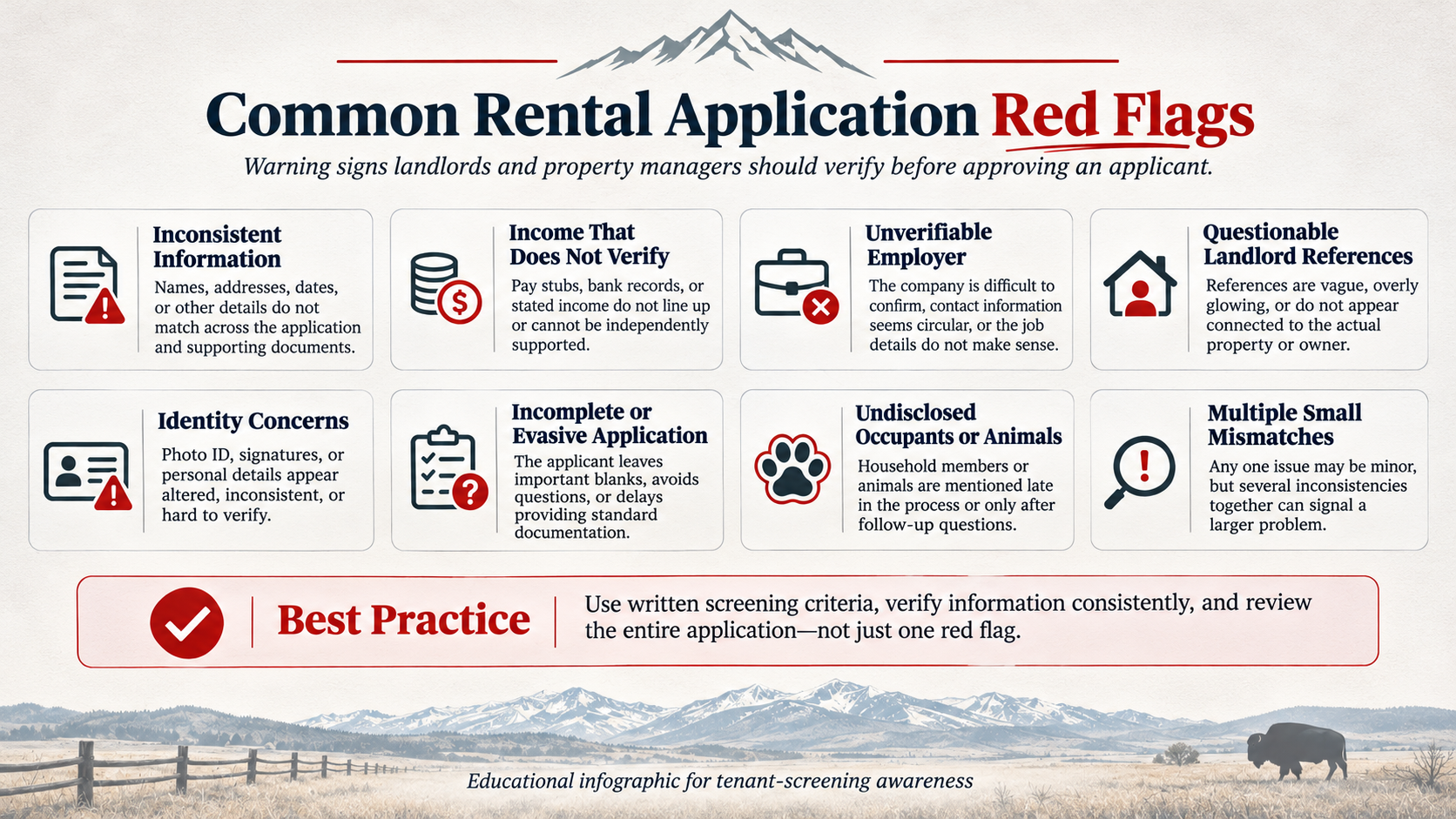
1) Start with written screening criteria
Before you screen anyone, decide in writing what standards you will use.
This is where many landlords get themselves into trouble. They think screening starts when the application arrives. It does not. Screening starts when you establish the rules you will apply to every applicant, every time.
A solid written screening policy typically addresses:
- minimum income expectations
- how credit is reviewed
- acceptable documentation for income and identity
- rental-history requirements
- occupancy limits
- treatment of co-signers
- how multiple applicants will be evaluated
- criminal-history review where legally permitted
- how pets, service animals, and assistance-animal requests are handled
- what triggers denial, conditional approval, or additional documentation
Written criteria help you make better decisions, train staff, explain denials, and stay consistent. I regularly explain to my staff that application screening is a means of identifying risk. All risk can be mitigated if you understand the tools available. Having a detailed, consistent screening process ensures we identify the risk level, which then gives us opportunities to mitigate that risk.
2) Identity verification comes first
Before you spend much time evaluating the rest of the application, confirm the applicant is who they say they are.
That sounds obvious, but identity issues can undermine the entire file. If identity cannot be verified, nothing else in the application can be trusted.
Basic identity review should include:
- government-issued photo ID
- matching name across the application and supporting documents
- matching addresses across the application and supporting documents
- consistent date of birth, social security number, and other personal identifiers
- signs that documents have been altered or do not appear genuine
- reasonable consistency between the applicant’s claimed employment, income, and personal details
You do not need to become a forensic examiner, but you do need to slow down and make sure the file makes sense before moving forward.
3) Credit matters—but it is only one part of the picture
Credit can be useful, but it is often misunderstood.
A credit report may help identify payment patterns, outstanding collections or judgments, delinquent accounts, or prior housing-related obligations. But a score alone does not tell you the full story. A lower score with stable income, verified employment, and solid rental history may be less risky than a better score paired with questionable documentation.
Use credit as a context tool, not a shortcut.
Also remember: if a consumer report affects your decision—whether you deny the application, require a co-signer, require a higher deposit where allowed, or otherwise impose less favorable terms—FCRA adverse-action obligations may apply.
4) Review debt in relation to income
A tenant may have decent income on paper and still be stretched too thin, but there are always exceptions. For example, an applicant making $4,000 a month may have so much debt that they can only afford a $1,000 rental. On the other hand, an elderly person with no debt making only $2,000 a a month may be able to afford the same rental.
That is why income should be reviewed alongside major financial obligations. The real issue is whether the applicant appears able to handle rent reliably after accounting for the rest of life’s financial demands.
This does not mean you need to underwrite like a mortgage lender. It means you should look at the application as a whole and ask whether the financial picture is believable, stable, and sustainable.
5) Verify income, don’t just collect it
One of the most common mistakes landlords make is confusing submitted income documents with verified income.
An application may include pay stubs, bank statements, offer letters, or tax returns. Landlords need to be on the ball because all of these documents can be faked online, for free, in just minutes!
Income verification should answer four questions:
- Does the documentation appear authentic?
- Does it match the application?
- Is the income current and ongoing?
- Is there independent support for the claim?
The more pressure there is to fill a vacancy, the more important it is to slow down here.
6) Employment verification should be independent
Employment is one of the easiest parts of an application to fake if the landlord performs only surface-level checks.
A proper employment review should confirm:
- that the employer exists
- that the applicant actually works there
- whether the position appears current
- whether the compensation generally aligns with what was represented
Where appropriate, verification should be obtained from a legitimate, independently sourced business contact—don't just rely on the phone number or email address provided in the application.
7) Rental history still tells you a lot
Rental history remains one of the most useful screening tools available.
A past landlord—or at least a verifiable housing history—may help answer questions that no credit report can fully answer:
- Did the tenant pay on time?
- Did they give proper notice?
- Did they follow lease terms?
- Was the property left in acceptable condition?
- Were there repeated disturbances or lease violations?
That said, rental history should be reviewed carefully. Not every reference is reliable, and not every prior housing situation is easy to document.
8) Landlord references should be approached carefully
A landlord reference is only helpful if it is credible.
Some references are incomplete. Some are overly vague. Some turn out not to be actual landlords at all. In other cases, a current landlord may have an incentive to give a glowing reference simply because they want a difficult tenant to move out.
That does not mean landlord references are useless. It means they should be treated as one piece of a larger verification process, not as a final answer.
9) Criminal-history review requires caution
Where criminal-history screening is used and legally permitted, landlords should be careful, consistent, and well-advised.
The FTC specifically notes that criminal-history reports obtained through a consumer-reporting agency are consumer reports covered by FCRA, which means adverse-action requirements may apply if that information influences the decision.
Fair Housing issues can also arise if criminal-history policies are overly broad or inconsistently applied. HUD has issued multiple guidance documents on this subject over time, and some prior guidance has been withdrawn or changed, so landlords should avoid blanket assumptions and use current legal review when setting criminal-history criteria.
At American West Realty and Management, we consider various factors regarding criminal history. The key issue: does the applicant still pose a threat to the property, the neighbors, or our staff?
10) Check eviction records, but verify context
Eviction-related information can be important, but it should be interpreted carefully.
Not every filing ends in removal. Not every record tells the full story. A landlord should verify what the record actually shows and how that fits within the written screening criteria.
The goal is not to overreact to a single data point. The goal is to consistently evaluate material housing-risk information.
11) Fraudulent pay stubs are a real issue
Application fraud is not theoretical. It happens.
One of the more common categories involves income documents that look acceptable at first glance but do not hold up under review. Sometimes numbers do not match across documents. Sometimes formatting is inconsistent. Sometimes the employer or pay structure does not make practical sense. Sometimes the file simply has too many small inconsistencies to ignore.
The lesson is simple: review supporting documents like a skeptic, not a spectator.
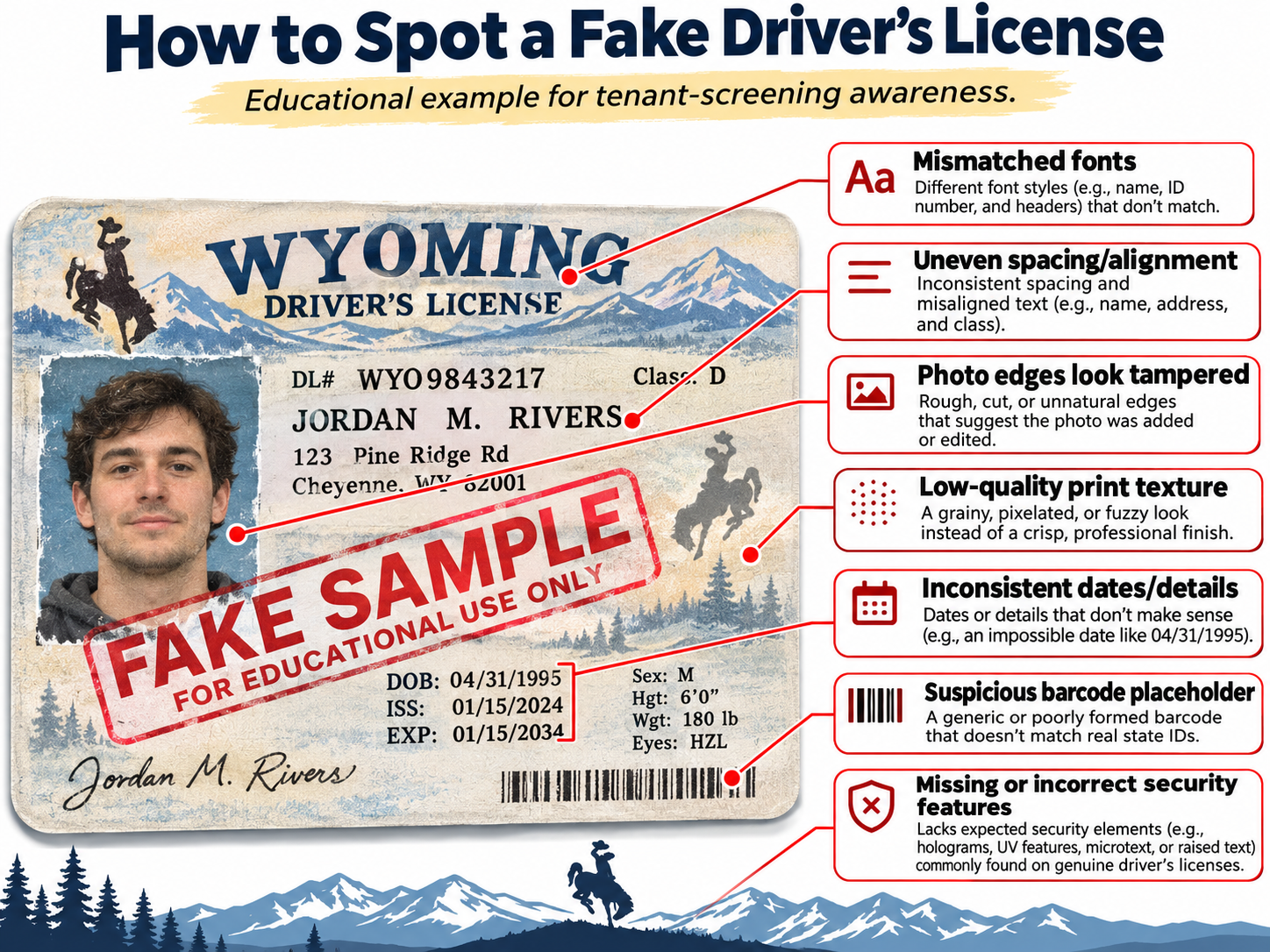 12) Fake IDs do exist
Most applicants are legitimate. Some are not.
When an ID raises concerns, the problem is not just the identification itself—it is that the entire application becomes suspect. If the person’s identity is uncertain, everything downstream becomes unreliable.
The right response is not accusation or confrontation. The right response is a documented, consistent verification process and, where necessary, a request for acceptable supplemental documentation.
13) Fake employers are easier to create than many landlords realize
Self-managing landlords often assume that if someone answers the phone and sounds professional, employment has been verified.
That is not always the case.
An applicant may provide a contact that appears legitimate on the surface but does not actually provide reliable third-party verification. That is why independent business verification matters. If the company is difficult to verify or the contact information appears circular, that is a signal to proceed carefully.
14) Fake landlord references are also common
Sometimes the “landlord” is a friend. Sometimes it is a relative. Sometimes it is someone coached to say the right things.
That is why screening should not depend on a single phone call. Prior addresses, ownership records, lease history, and overall file consistency all help determine whether the reference is credible.
15) Multiple applicants need clear rules too
Applications with roommates, co-applicants, guarantors, or mixed income sources can create confusion unless you have a clear policy.
Important questions include:
- Do all adult occupants apply?
- Are all applicants screened individually?
- Can one strong applicant offset one weak applicant?
- When is a guarantor allowed?
- How is household income counted?
- What happens if one applicant qualifies and the other does not?
The best practice is to answer those questions in your written criteria before the first application arrives.
16) Animals and assistance-animal requests must be handled correctly
This is an area where many landlords accidentally create legal exposure.
A pet policy is one thing. A disability-related request for an assistance animal is another. HUD states that an assistance animal is not a pet and that housing providers may need to make a reasonable accommodation when the legal requirements are met. HUD’s assistance-animal guidance explains that an accommodation may include allowing the animal at a property with a no-pets policy or waiving pet-related fees or rules, when appropriate.
That means screening policies should clearly separate:
- pets
- service animals
- assistance or emotional-support animal accommodation requests
Staff should know the difference, and the process should be consistent.
17) Fair Housing consistency matters as much as screening quality
A poor screening decision can cost you money. An inconsistent screening process can create legal risk.
That is why consistency is so important. The same written criteria should be applied to all applicants, with documented procedures for follow-up questions, supplemental documentation, and final decisions.
The Fair Housing Act prohibits discrimination in rental housing on protected bases, and landlords should avoid ad hoc decision-making that can look selective, subjective, or uneven.
18) Ten application-fraud attempts we have actually seen
Below is a fully anonymized list of the kinds of fraud or misrepresentation issues a working property management company may encounter. I am intentionally keeping these at a high level so this article does not become a how-to manual for fraud.
- Income documents that did not match each other.
- Employer information that could not be independently supported.
- References that appeared connected to the applicant rather than to the claimed company or landlord.
- IDs that raised questions because the file contained mismatched supporting information.
- Applications where address history changed depending on the document reviewed.
- Household composition that was not fully disclosed up front.
- Animal information that changed only after conditional review began.
- Rent amounts listed on the application that did not line up with prior-housing information.
- Timeframes for employment or residency that overlapped in unrealistic ways.
- Applications that appeared polished at first glance but became unreliable when details were cross-checked.
The point is not that every inconsistency means fraud. The point is that screening is a verification process, and the most important discoveries often come from comparing one part of the file against another.
19) Frequently asked questions
Is credit score the most important part of tenant screening?
No. It can be useful, but it is only one factor. Identity, income, employment, rental history, and consistency across the file often tell you more.
Should I deny every applicant with bad credit?
Not automatically. Your review, based on your written screening criteria, should identify the level of risk based on the complete file.
Can I rely on pay stubs alone?
No. Submitted documents should be reviewed and verified, not simply accepted at face value.
What if I use a screening report and deny the application?
If a consumer report influenced your decision, FCRA adverse-action rules may apply. The FTC says that even if the report was only part of the reason, notice may still be required.
Can I reject an applicant because of an emotional support animal?
Do not treat an assistance-animal request like a normal pet issue. HUD states that assistance animals are not pets and may require a reasonable accommodation when the applicable standards are met.
Should I use the same screening standards for everyone?
Yes—subject to lawful accommodations and your written policy. Consistency is essential for both better decisions and Fair Housing compliance.
Final takeaway
If you are a landlord in Cody or anywhere in Wyoming, the best screening system is not the one that feels toughest. It is the one that is documented, consistent, verifiable, and legally aware.
Credit score has its place. But by itself, it rarely tells the story that matters most.
The real job of tenant screening is to answer a bigger question:
Can this application be trusted, verified, and approved under the same standards you would apply to every other applicant?
Resource Links
Need help screening tenants the right way?
If you own rental property in Cody, Powell, or surrounding areas, contact American West Realty and Management to discuss leasing-only services or full property management.